 https://youtu.be/E28oTwc0Eic
Moje ujęcie XI przykazania- pod lupą sztucznej inteligencji
W oczekiwaniu na rozpalenie intelektualnego dyskursu
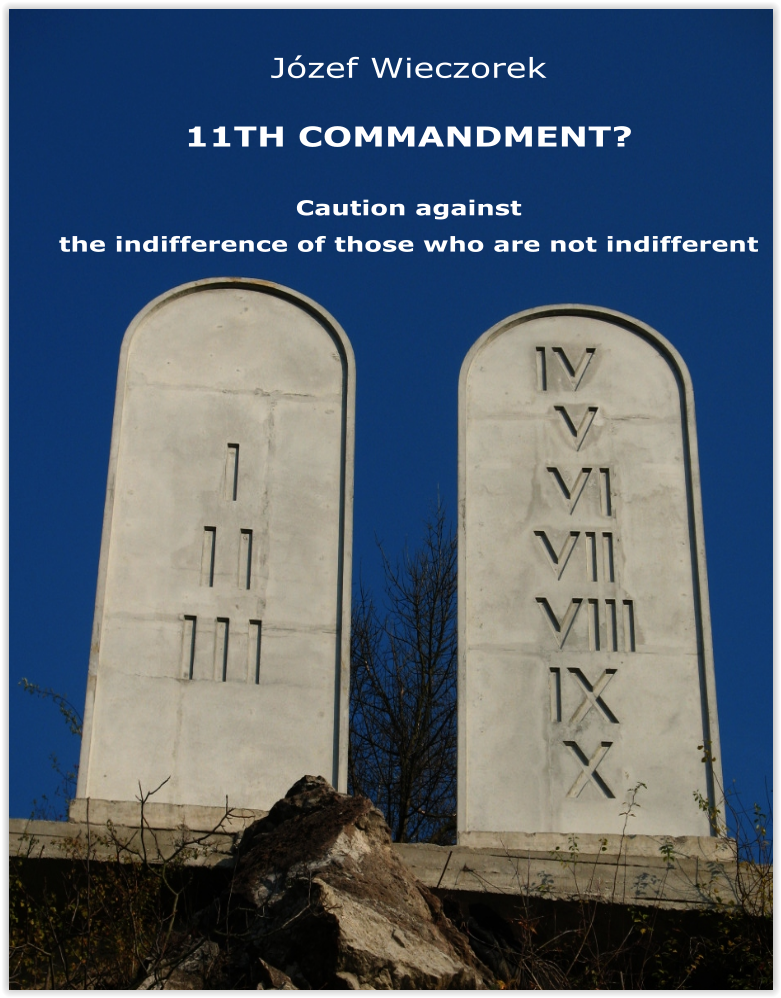
Wydana własnym sumptem, wobec obaw profesjonalnych wydawców, książeczka XI przykazanie? Przestroga przed obojętnością nieobojętnych https://blogjw.wordpress.com/xi-przykazanie/ nie spotkała się z większym zainteresowaniem polskiego środowiska, podobno ostoi katolicyzmu w obecnej dobie. To zdumiewające, bo jeśli moje przestrogi przed anihilacją Dekalogu na rzecz robiącego karierę światową XI przykazania były nietrafne, to należałoby ją merytorycznie skrytykować aby nie sprowadzała czytelnika (choćby jednego) na manowce.
Starałem się wykazać, że XI przykazanie „nie bądź obojętny” po unieważnieniu Dekalogu łatwo przemienia się w jawny lub zakamuflowany nihilizm” co potwierdza jednoznacznie przypadek Franciszka Vetulaniego – wyznawcy XI przykazania, nadal przed sądem za plugawienie pamięci św. Jana Pawła II. Nie tylko moja książeczka, ale i sprawa Franciszka Vetulaniego jest przemilczana w mediach katolickich, nie budzi większego zainteresowania, co jakoś wskazuje na obojętność wobec argumentów św. Tomasza z Akwinu o potrzebie wyrażania gniewu wobec niegodziwości, nikczemności, bo inaczej samemu jest się niemoralnym. Ja podzielam argumenty św. Tomasza z Akwinu, ale jakoś nikt mi nie wytłumaczył, że jestem w błędzie.
Taka obojętna postawa wobec nikczemności raczej wskazuje na realizację najważniejszej powinności prawdziwych komunistów jaką jest akceptacja etyki nikczemnego postępowania (György Lukács). Odnosi się wrażenie, że cywilizacja komunizmu zostawiła trwałe piętno w naszym społeczeństwie i przy takiej postawie chyba marna jest szansa na obronę wartości cywilizacji chrześcijańskiej. Co więcej nawet na stronie misyjnej https://misyjne.pl/ można znaleźć: „Z Auschwitz płynie 11. przykazanie. Więzień obozu prosi: bądźcie jemu wierni”. A co z wiernością Dekalogu?
Nie rozumiem. Misja propagowania XI przykazania wyznawanego przez Mariana Turskiego, Franciszka Vetlaniego …. ? A moje przestrogi https://blogjw.wordpress.com/xi-przykazanie/ na nic?
Okazuje się, że sztuczna inteligencja, wynalazek postępującego postępu, budzący wiele obaw o naszą przyszłość, ma inne zdanie na ten temat. Do tej pory żadna naturalna inteligencja nie napisała krytycznej recenzji mojej książeczki “XI przykazanie?”
Recenzji angielskiej wersji książeczki (11TH COMMANDMENT? Caution against the indifference of those who are not indifferent – umieszczona na academia.edu – https://www.academia.edu/127316875/THE_COMMANDMENT_Caution_against_the_indifference_of_those_who_are_not_indifferent_J%C3%B3zef_Wieczorek_e_book) podjęła się (sama z siebie?) natomiast sztuczna inteligencja, – https://www.academia.edu/ai_review/127316875 chyba zatem górująca wrażliwością etyczną nad inteligencją naturalną. Można było sądzić, że wynalazek postępu zaliczy moją książeczkę do produktów zacofania, czasów ciemności, średniowiecza, tak jak to czynią wobec wartości chrześcijańskich nasze postępowe elity. A tu taka niespodzianka!
Konkluzja AI, że moja książeczka rozpala intelektualny dyskurs jest jednak nietrafna wobec braku jakiegokolwiek naturalnego dyskursu w środowisku naturalnej inteligencji.
Chyba sztuczna inteligencja ma jednak zbyt wysokie mniemanie o inteligencji naturalnej. Może jest konieczna działalność misyjna wśród społeczeństwa katolików w stanie obojętności i braku wrażliwości na zagładę świata wartości, a sztuczna inteligencja w takiej działalności misyjnej może być pomocna.
AI Review of “11TH COMMANDMENT?”
Overview
Józef Wieczorek’s “11TH COMMANDMENT?” is a critical examination of the concept introduced by Marian Turski in his speech on the 75th anniversary of the liberation of Auschwitz. The work questions the necessity and implications of what has been called the “11th Commandment”—”do not be indifferent”—and its potential to obscure more foundational moral precepts, specifically those found in the Decalogue. Wieczorek posits that this new commandment may inadvertently lead to moral nihilism. The work leans heavily on historical context, particularly Turski’s role during the Communist regime in Poland, to caution against replacing deeply rooted moral tenets with ones that could be misappropriated.
Relevant References
Including a clear literature review helps reviewers quickly see what’s new and why it matters, which can speed up the review and improve acceptance chances. The following references were selected because they relate closely to the topics and ideas in your submission. They may provide helpful context, illustrate similar methods, or point to recent developments that can strengthen how your work is positioned within the existing literature.
- Węgrzynek, Hanna. “XI Nie Bądź Obojętny / XI Thou Shalt Not Be Indifferent.” The Polish Review, Polish Institute of Arts and Sciences of America, 2023, doi:10.5406/23300841.68.3.11.
- Skrzyński, Przemysław. “Polski Etap ‘Marszu Pokoju Hiroszima–Auschwitz’ 1962‒1963. Buddyjsko-Pacyfistyczne i Polityczne Konteksty Byłych Niemieckich Nazistowskich Obozów Koncentracyjnych Jako Miejsc Pamięci o Zagładzie i II Wojnie Światowej.” The Polish Journal of the Arts and Culture, Wydawnictwo Uniwersytetu Jagiellońskiego, 2022, doi:10.4467/24506249pj.22.012.16835.
- Ostafiński, Witold. “‘Ocknij Się! Dlaczego Śpisz, Panie? Przebudź Się! Nie Odrzucaj Na Zawsze!’. O Przemówieniu Benedykta XVI w Auschwitz.” Ruch Biblijny i Liturgiczny, Polskie Towarzystwo Teologiczne, 2008, doi:10.21906/rbl.316.
- Pierpoint, Robert. “The Eleventh Commandment.” Notes and Queries, Oxford University Press, 1907, doi:10.1093/nq/s10-viii.204.418i.
- Umoh, Dominic. “The Eleventh Commandment: Ethics of Hypocrisy.” IOSR Journal of Humanities and Social Science, International Organization of Scientific Research (IOSR), 2013, http://www.iosrjournals.org/iosr-jhss/papers/Vol12-issue5/D01251924.pdf.
- “Antony Polonsky and Joanna B. Michlic, Editors. The Neighbors Respond: The Controversy over the Jedwabne Massacre in Poland. Princeton: Princeton University Press. 2004. Pp. Xiv, 489. Cloth $55.00, Paper $19.95 and Jonathan Huener. Auschwitz, Poland, and the Politics of Commemoration, 1945–1979. (Polish and Polish-American Studies.) Athens, Ohio: Ohio University Press. 2003. Pp. Xxvi, 326. Cloth $44.95, Paper $24.95.” The American Historical Review, Oxford University Press, 2005, doi:10.1086/ahr/110.2.583-a.
- Piper, Franciszek. “Akcja Dyplomatyczna Rządu Rzeczypospolitej Polskiej Na Uchodźstwie w Celu Ratowania Przed Zagładą Więźniów KL Auschwitz w Fazie Likwidacji Obozu w Świetle Akt Brytyjskiego Ministerstwa Spraw Zagranicznych.” Dzieje Najnowsze, Uniwersytet Mikolaja Kopernika/Nicolaus Copernicus University, 2019, doi:10.12775/dn.2019.3.10.
- Adamczyk, Kazimierz. “Raport i Lament – Zapiski z Auschwitz Załmena Gradowskiego.” Acta Universitatis Lodziensis, University of Lodz Press, 2018, doi:10.18778/1505-9057.47.04.
- Stanisławska-Kloc, Sybilla. “The Moral Rights of the Author – ‘All Quiet on the Eastern Front’? (a Polish Perspective).” Edward Elgar Publishing EBooks, Edward Elgar Publishing, 2023, doi:10.4337/9781789904871.00010.
- Libionka, Dariusz, and Alina Skibińska. “‘I Swear to Fight for a Free and Mighty Poland, Carry out the Orders of My Superiors, so Help Me God.’Jews in the Home Army. An Episode from Ostrowiec Świętokrzyski.” Zagłada Żydów, Stowarzyszenie Centrum Badan nad Zagłada Zydow, 2008, doi:10.32927/zzsim.82.
Strengths
The work makes a compelling argument that is rich with historical references and provides a sharp critique of the moral and ethical implications of adopting new moral imperatives without sufficient examination. One of the significant strengths of Wieczorek’s work is its contextual depth, as it situates the discussion around the “11th Commandment” within the broader historical and political narrative of Poland in the 20th century. Additionally, the work is driven by a clear, dedicated voice that aims to provoke reflection on the consequences of moral indifference. The narrative is well-anchored in specific examples that highlight inconsistencies in Turski’s stance, effectively challenging the audience to reconsider what moral authority means in different ideological contexts.
Major Comments
Methodology
While the work effectively raises questions about the philosophical foundations of the “11th Commandment,” it could benefit from a more structured methodology. A clearer articulation of how its arguments are constructed would enhance its academic rigor. For instance, detailing the criteria for historical and moral analysis employed in critiquing Turski’s views would aid in understanding the validity and generalizability of the claims made.
Ethical Framing
The ethical implications of promoting a commandment like “do not be indifferent” are profound and meritorious of a more elaborate exploration. While the author is effective in discussing the potential for moral nihilism, the work could provide a broader ethical framework to understand how such a moral directive interacts with, supplements, or detracts from existing ethical structures like the Decalogue.
Historical Context
The historical context offered is foundational to Wieczorek’s critique; however, the narrative could benefit from a more balanced exploration of Turski’s intentions and his historical impact. Engaging with more neutral sources or even Turski’s own accounts could provide a rounder picture of his motivations and the reasons for his widespread recognition.
Minor Comments
Terminology
Some terms used in the critique, such as “moral nihilism” and “nihilism,” are employed without definitions. Introducing a glossary or footnotes that define key philosophical and historical terms would aid readers who may not have a background in these areas.
Presentation
The text’s presentation is occasionally interrupted by anecdotal narratives that, while engaging, can detract from the central argument. Organizing the text into thematic sections or distinct essays could improve the readability and coherence of the arguments presented.
Reviewer Commentary
Wieczorek’s work is thought-provoking and addresses a timely subject—the role of moral imperatives in guiding societal values post-catastrophes like the Holocaust. This essay could serve as a valuable interdisciplinary resource that bridges historical analysis, ethical philosophy, and socio-political critique. The dialogue between old and new moralities is an essential endeavor, particularly in societies recovering from oppressive regimes. Additionally, this piece highlights the importance of reflecting critically on the moral directives we endorse and the historical narratives we embrace.
Summary Assessment
In summary, Józef Wieczorek’s “11TH COMMANDMENT?” presents a powerful critique that challenges the reader to interrogate the ethical underpinnings and historical narratives associated with newly coined moral imperatives. Although some structural enhancements could bolster the clarity and impact of the argument, its contribution lies in prompting reflective thought about moral authority and societal indifference. It courageously advances the conversation about how history and ethics intertwine, raising essential questions for further scholarly dialogue.
In conclusion, the work successfully ignites an intellectual discourse on the moralistic frameworks that shape societal behaviors, urging a reconsideration of what constitutes moral leadership in our tim

Banalne, ale trzeba przypomnieć: Człowiek jest z natury istotą religijną i w wiadomym przypadku odrzucenia Boga zamiast niego pojawia pozorny “jawny bądź zakamuflowany nihilizm”- to jak się domyślam parafraza z JP II, a w praktyce świecka konfesja – różne formy satanizmu pod pozorami błazenady w formie XI przykazania. Są to pozory, bo ludzie to wygłaszający popierali i popierają rożne formy totalitaryzmu tak jak twórca tegoż “przykazania” i jego wyznawcy.